Finding people when every second counts
After an earthquake or a building collapse, rescuers need to know one thing fast: is someone alive in there? Cameras fail in smoke, dust and darkness. A small 60 GHz radar does not. It can sense a person walking, and even the tiny chest movement of someone breathing, through debris and in complete darkness.
That is the idea behind one of the use cases in Cynergy4MIE. Our industrial partner Strikersoft has built a radar application that detects people for search and rescue teams. At KTH, we are designing the chip that will run it, so the sensor can sit on a drone or in a handheld device and work for hours on a small battery.
The challenge: smart sensing on a tiny energy budget
A radar that finds and recognises people has to do a lot of maths. Every frame, it turns raw radio echoes into a 3-D picture of the scene. It then follows each moving object over time and asks a neural network what each object is. Running all of this on a general-purpose processor works, but it is slow and drains the battery. FPGAs, the reprogrammable chips often used for prototypes, avoid the design cost. However, they spend much of their area and energy on flexibility the application never uses. The usual answer is custom hardware: a chip built for one job does it faster and with far less energy. But custom chips are very expensive to design.
SiLago: chips built like LEGO
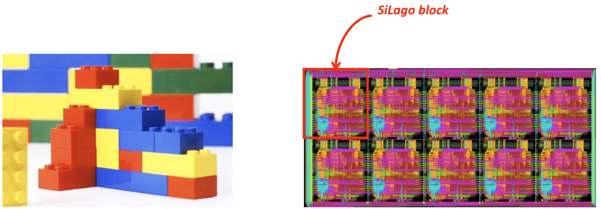
This is where SiLago, developed at KTH comes in. SiLago builds chips from a set of ready-made, tested blocks, much like LEGO bricks. Some blocks do arithmetic, some store data, and a few small processors handle the decision-making. The blocks fit together on a common grid, so creating a new chip is mostly a matter of choosing and arranging them.
Because every brick is already known, designers can see how fast and how power-hungry a design will be before anything is manufactured. They can try hundreds of options in minutes rather than months. Earlier studies showed that SiLago chips come close to the efficiency of fully custom chips while being far easier to create.
Blog signed by: KTH team