Satellite data is often associated with weather forecasts or spectacular images of Earth from space. In Cynergy4MIE, we are using it in a more practical way: to detect changes on the ground after an earthquake and turn them into information that can support faster, smarter responses. Our work focuses on post-earthquake scene analysis for search-and-rescue operations, using satellite radar to provide a rapid wide-area view of where the strongest impacts may have occurred.
When an earthquake strikes, one of the biggest challenges is understanding the scale of the damage as quickly as possible. Roads may be blocked, buildings may be unsafe, and the affected area can be far too large for emergency teams to assess immediately on the ground. In these situations, having a fast and reliable overview can make a real difference.
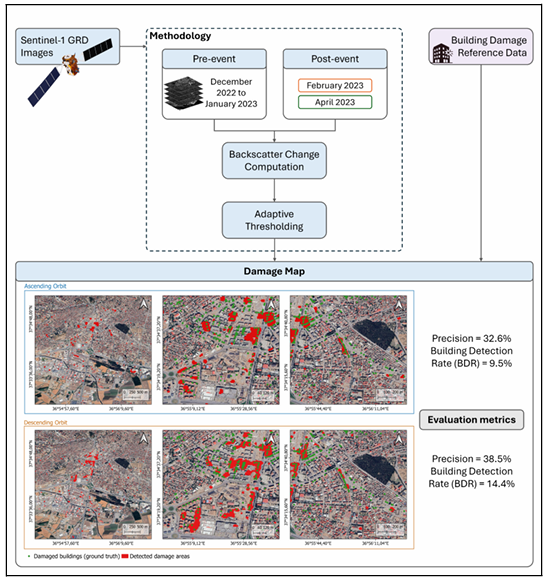
This is where satellite radar comes in. Unlike ordinary optical imagery, radar can work day and night and is much less affected by clouds or bad weather. That makes it especially valuable in the first hours and days after a disaster, when time matters most and on-the-ground information may still be limited. In Cynergy4MIE, we use Sentinel-1 satellite data collected before and after an earthquake to detect places where the radar signal has changed significantly, which can point to surface disruption or structural damage.
Our approach has been explored using real earthquake cases in Türkiye, including the 2023 Gaziantep earthquake and the 2025 Balikesir-Sindirgi earthquake. By comparing radar observations from before and after these events, we can create disruption maps that highlight zones likely to have been strongly affected. These maps are not meant to replace field teams. Instead, they provide an early screening layer that helps responders understand where closer inspection may be needed first.
That idea is central to our contribution in Cynergy4MIE. The satellite view provides the wide-area overview, while downstream systems can use that information for mission planning, local inspection, and more detailed mapping. In practice, this means satellite-derived hotspot maps can help guide where autonomous systems or rescue teams should be deployed, making emergency response more targeted and more efficient. The project architecture describes this flow clearly: from satellite-based screening to mission prioritization and then to localized exploration on the ground.
The results so far are encouraging. They show that Sentinel-1 radar data can rapidly outline zones of seismic impact and support post-earthquake response mapping. They also show that timing and viewing direction matter: later post-event images can sometimes provide more stable damage signatures, and different satellite geometries may reveal damage differently depending on the layout of the city and the orientation of terrain and buildings. These are important lessons for improving how such methods can be used in future emergency situations.
What makes this work exciting is not only the technology itself, but what it enables. In an emergency, better situational awareness can support faster decisions, better allocation of resources, and safer deployment of people and autonomous systems. By combining space-based observations with ground-level exploration, Cynergy4MIE is contributing to a more connected, practical, and proactive approach to disaster response.