
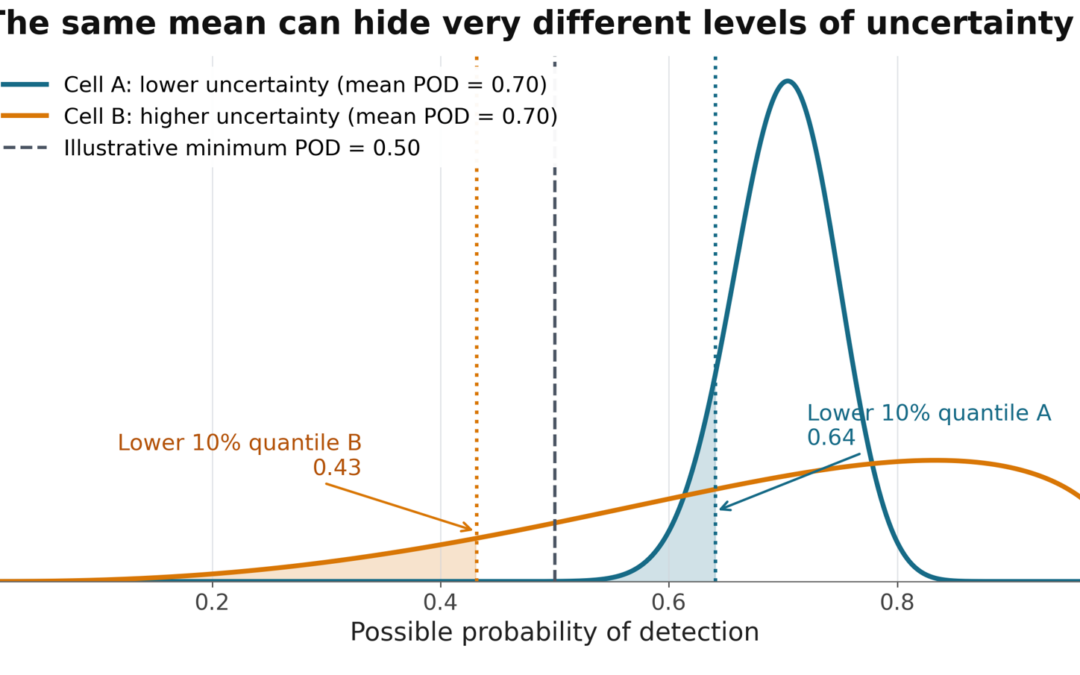
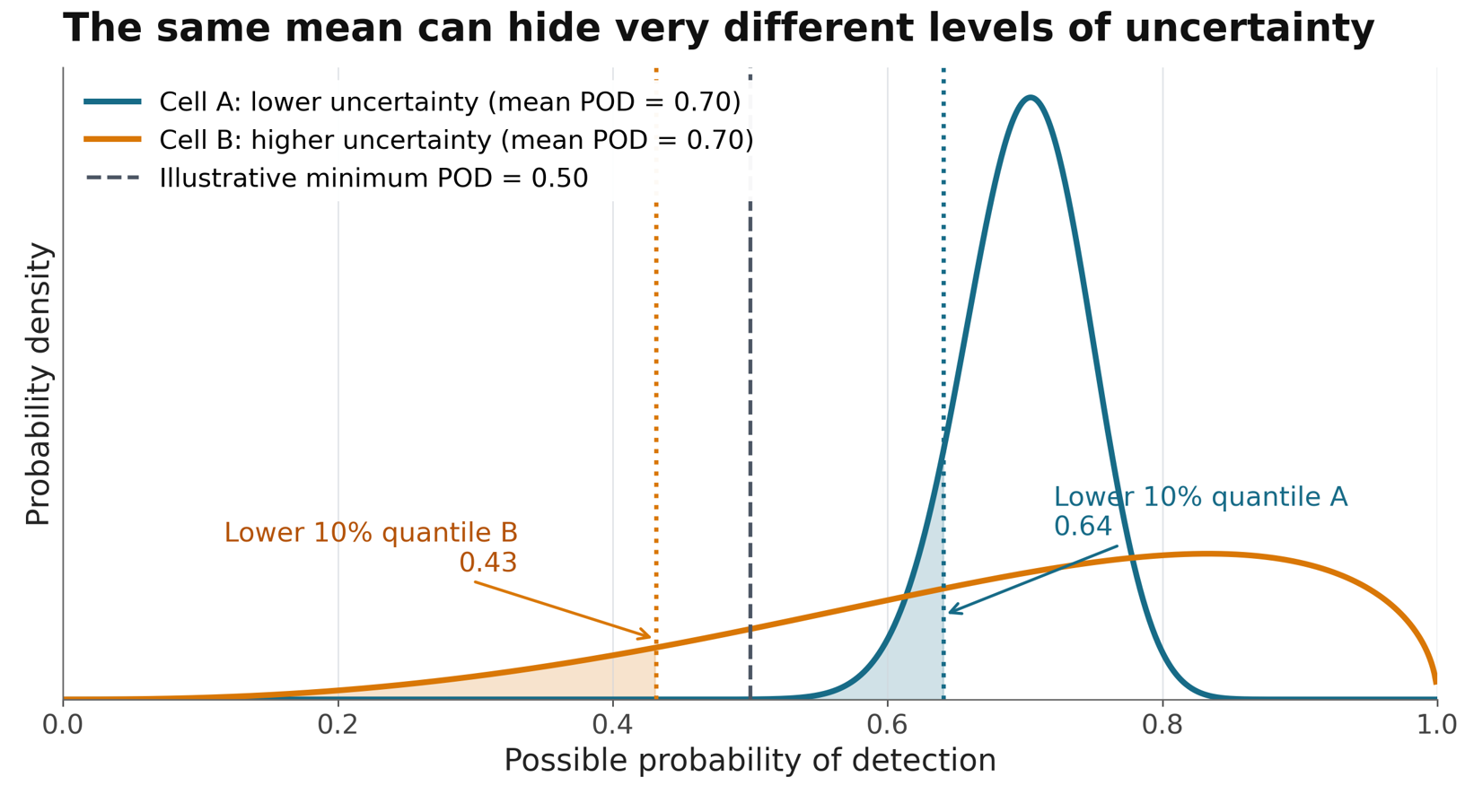
Figure 1. Two illustrative POD distributions with the same mean. The lower quantile reveals that one estimate is subject to substantially greater uncertainty than the other. The values are schematic and do not represent project results.
The lower 10% quantile in the figure marks a value that the POD is expected to exceed in 90% of the represented cases, provided that the statistical model is well calibrated. A planner that uses only the mean treats the two cells as equivalent. A planner that also considers the lower quantile recognises that the second estimate may be too uncertain to meet an operational minimum.
How uncertainty changes a mission decision
We are investigating a central mission planning approach for coordinating multiple UAVs. The UAVs execute the assigned tasks, while one central planner decides which cell each available UAV should search next. External models provide time-dependent estimates of search conditions. The planner can then use these time-dependent estimates and their uncertainty in three practical ways.
- Safer eligibility checks. A cell may be searched only if a conservative lower POD estimate remains above a required minimum and a conservative upper fire-risk estimate remains below the safety limit.
- More balanced priorities. Among the cells that are safe to search, the planner can combine expected search value with a lower, more cautious estimate. This prevents a highly uncertain cell from being favoured solely because its average looks attractive.
- Decisions for the expected arrival time. Fire conditions and detectability can change while a UAV is travelling. The relevant values are therefore those predicted for the start of the search, not only those observed when the assignment is made.
The planner can repeat this process whenever new information becomes available or a UAV completes a task. A short look-ahead may also consider one hypothetical follow-up search. Only the next task is assigned, however. The later step is reconsidered when the situation is updated. This keeps the plan responsive instead of fixing a long route that may quickly become outdated.
Better outcomes do not always mean a higher average
Accounting for uncertainty does not guarantee that every mission will find more victims. It changes the balance between average performance and exposure to poor outcomes. A strategy based only on mean values may perform very well when its optimistic assumptions are correct, but badly when they are not. An uncertainty-aware strategy can accept a small reduction in the average result if it substantially improves performance in difficult cases.
This lower part of the outcome distribution matters in search and rescue. An early assignment can keep a UAV busy for a considerable time. If the selected cell turns out to have poor detectability or worsening fire conditions, the opportunity to search other cells may be lost. Reducing the frequency and severity of such decisions can be valuable even when the improvement is not fully visible in the mean alone.
Uncertainty estimates must be reliable
Quantiles are useful only when the underlying distributions are credible. Sensor noise, differences between devices, model errors and changes over time must be reflected in the estimates. Dependencies also matter: smoke may simultaneously increase fire-related danger, reduce visibility and lower the probability of detection. If these effects are modelled separately without preserving their connection, the planner may still underestimate a jointly unfavourable situation.
Testing the benefit in realistic simulations
The benefit can be tested by comparing three decision rules under identical simulated disaster conditions: the mean-based planner seeks high average performance using only mean estimates of the uncertain parameters. The quantile-based planner pursues the same objective but accounts for estimation uncertainty by replacing means with suitable parameter quantiles. The mean-and-tail-risk planner goes one step further: it seeks high average performance while simultaneously reducing the risk of particularly poor mission outcomes by explicitly considering the lower tail of the mission-performance distribution.
Relevant measures include the share of victims actually found over time, the time needed to reach a given search target, and the lower end of the outcome distribution across many missions. This reveals whether uncertainty-aware planning improves the average search result, protects against poor missions, or achieves both.
Better decisions with imperfect information
No planner can remove uncertainty from a disaster response. It can, however, account for that uncertainty rather than relying on a single best estimate. Lower and upper quantiles can support safer eligibility checks, while tail-risk-aware decision rules can seek high average search performance and simultaneously reduce the risk of particularly poor mission outcomes. The aim is not perfect prediction, but better next decisions that consider both the available estimates and their associated uncertainty.
Blog signed by: KFU team