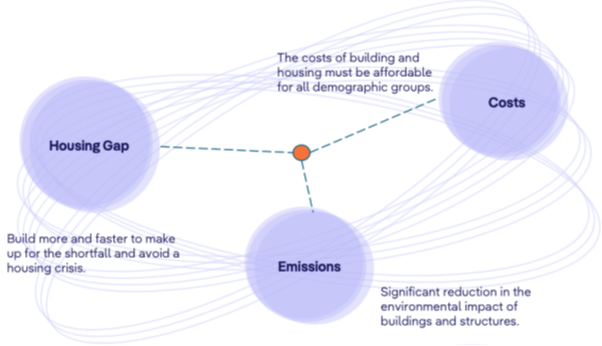
This creates one of the defining challenges of modern construction: how can we build more, spend less, and emit less, without compromising the quality and adaptability of the built environment?
Yet residential construction differs fundamentally from many other industries. Buildings cannot simply be replicated from a single blueprint. Every project must respond to unique site conditions, local regulations, energy requirements, and functional needs. Whether shaped by the dimensions of a plot, municipal planning requirements, or the intended use of the building, design variation is often a necessity rather than a choice.
This means the solution is not simply to build more homes. The challenge is to deliver housing at the scale required to address Europe’s housing shortage while retaining the flexibility needed to accommodate unique project requirements.
Unique at Scale
This vision forms the foundation of our approach to housing production and our participation in the European research project Cynergy4MIE.
From Vision to Factory Reality
GROPYUS believes the future of construction lies in applying the principles of modern manufacturing to housing production. The objective is simple: deliver unique buildings with the efficiency, quality, and reliability of an industrial process.
Every GROPYUS project starts as a digital model and moves through a connected value chain that links design, engineering, manufacturing, logistics, and assembly. This integrated approach creates a seamless flow of information, enabling scalable production while preserving the flexibility required by each project.
Realizing this vision requires continuous innovation. Through Cynergy4MIE, GROPYUS collaborates with partners across Europe to explore how digitalization, AI, and robotics can further advance the future of industrialized construction.
Enter Cynergy4MIE
No company can transform an industry alone. Unlocking the next generation of construction requires collaboration across disciplines, industries, and technologies.
This is where the European project Cynergy4MIE comes in. Bringing together leading industrial companies, technology providers, universities, and research organizations from across Europe, the project explores how digital manufacturing, artificial intelligence, robotics, and advanced system integration can accelerate the transformation of future production systems.
Within the project, GROPYUS leads Supply Chain 2 (SC2): Digital Manufacturing, Robotics, and AI for the Construction of Low-Emission Buildings. The supply chain brings together partners from both industry and academia, including TH Rosenheim, Brno University of Technology, IMA, NXP Semiconductors, TU Eindhoven, and SmartSol, combining expertise in construction, manufacturing, embedded systems, AI, robotics, and digital engineering.
For GROPYUS, Cynergy4MIE provides a unique environment to both contribute practical challenges from industrialized construction and learn from innovations developed in other manufacturing sectors. The collaboration enables ideas, technologies, and methodologies to be transferred across domains, helping accelerate innovation and reduce the gap between research and industrial application.
By connecting expertise from multiple sectors, Cynergy4MIE accelerates the development of future manufacturing solutions.
Turning Design into Production
Within Cynergy4MIE, GROPYUS focuses on a fundamental question: how can highly individualized buildings be manufactured with the efficiency, predictability, and scalability of industrial production?
To address this challenge, GROPYUS is developing and validating several digital technologies across the production value chain.
One area focuses on the automated generation of production information from digital building models. Each building design contains a vast amount of information that must ultimately be understood and executed within production. By automating the creation of production-ready outputs, engineering effort can be reduced while ensuring greater consistency throughout the process.
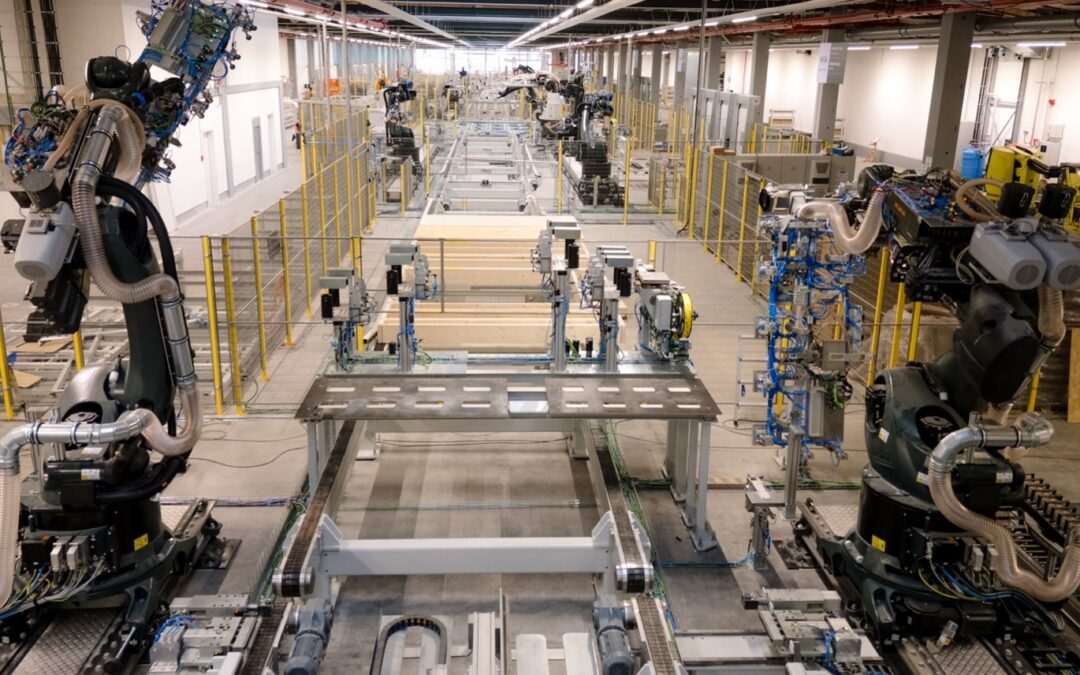
A second area explores how digital building information can be translated into tasks for automated production systems and robotic workstations. As manufacturing environments become increasingly automated, the ability to connect design information directly with production equipment becomes an important foundation for scalable and flexible manufacturing.
The third focus area addresses production planning and scheduling. Manufacturing highly customized building elements creates complex planning challenges involving machines, materials, production sequences, and delivery deadlines. Together with project partners, GROPYUS is investigating how advanced optimization methods and AI-supported approaches can help improve production efficiency while maintaining the flexibility required for mass customization.
Although these activities address different stages of the production process, they share a common objective: enabling a seamless transition from design intent to production execution.
By combining automation, robotics, and intelligent planning, GROPYUS aims to create production systems capable of delivering unique buildings with the speed and reliability expected from modern manufacturing.
The goal is simple: every unique building should be as easy to produce as the one before it.
Conclusion
The housing challenge Europe is facing cannot be solved through conventional approaches alone. Delivering the homes that are urgently needed will require new ways of designing, manufacturing, and assembling buildings that combine the efficiency of industrial production with the flexibility required by real-world projects.
Through Cynergy4MIE, GROPYUS is helping to explore and develop the digital technologies that can enable this transformation. By connecting digital design, automation, robotics, and intelligent production planning, GROPYUS is contributing to a future where housing can be delivered faster, more sustainably, and at greater scale without compromising the unique requirements of each building.
Unique at Scale. More than a slogan, it reflects a future where digital technologies enable sustainable housing to be delivered faster, smarter, and at the scale Europe urgently needs.
Blog signed by: GRO team