
Author: Jonathan Hoss, THRO
The Friction of the Deterministic Plan
Traditional manufacturing operations often rely on rigid, deterministic schedules predicated on ideal conditions—assuming zero equipment failure and perfect supply chain synchronization. In practical applications, however, this inflexibility creates severe operational liabilities.
To address the inherent uncertainty of real-world operations, facility managers traditionally build physical and temporal buffers into the system. For example, if a critical machine has a statistically documented breakdown rate, production planners will intentionally increase safety stock ahead of that node to absorb the shock of anticipated downtime. While this buffering strategy—a concept rooted in core Lean Manufacturing principles to stabilize flow—is often deployed alongside generic heuristics (e.g., the “Shortest Processing Time” rule) or manual pull-systems (e.g., Kanban) to build systemic robustness, it creates a fundamental manufacturing dilemma.
A shop floor is a highly interconnected, dynamic ecosystem. If an unpredictable disruption shifts the bottleneck to a new location, those static, preemptively placed inventory buffers become obsolete. Production stalls not from a lack of materials, but because the safety buffers are misaligned with the current state of the system.
While traditional tools offer a necessary baseline of stability, they treat every facility as a uniform entity. They fail to account for the unique topological characteristics of individual plants—specifically, dynamic buffer behaviors, machine interdependencies, and non-linear congestion patterns. This lack of systemic awareness manifests as a hidden operational tax in the form of extended lead times which, in modern manufacturing, directly translates to stagnant capital.
Mastering Complexity Through Granularity
To eliminate these inefficiencies, our research focuses on replacing generic rules with a framework capable of dynamic neural orchestration.
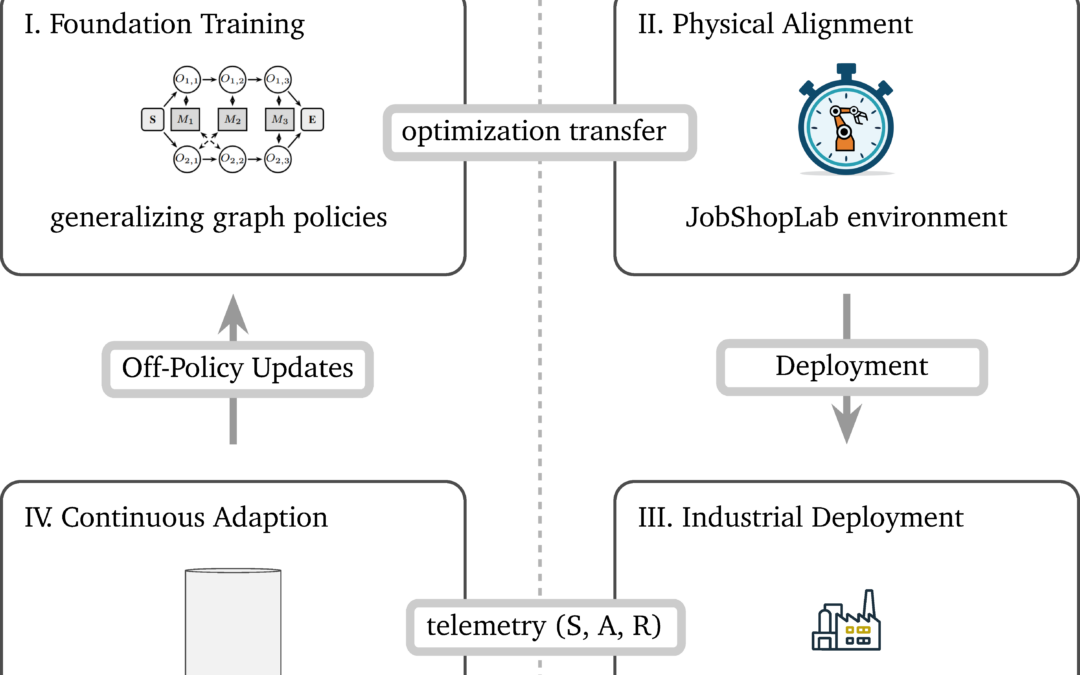
Directly training an AI on the chaotic data of a live factory is computationally prohibitive, while models trained purely on theory fail in reality. To bridge this gap, we employ a four-stage learning architecture:
- Foundation Training: The AI first learns the “grammar of flow” through rapid iterations in an abstracted environment, generalizing core scheduling policies without overfitting to real-world noise.
- Physical Alignment: The model transitions into high-fidelity simulations to integrate context-specific physical dynamics, aligning abstract rules with shop-floor reality.
- Industrial Deployment: The aligned policy is deployed for live, online scheduling, executing adaptive orchestration to actively minimize lead times and stagnant capital.
- Continuous Adaptation: A live telemetry feedback loop captures emergent physical dynamics, driving offline reinforcement learning to perpetually update and fine-tune the foundational model.
This iterative cycle enables the AI to master universal production principles before continuously adapting to the specific, idiosyncratic rhythm of any distinct manufacturing site.
The Vision: A Generalist Scheduling AI
The ultimate objective of this research is to architect a “Generalist” AI—a system that comprehends universal scheduling principles while retaining the agility to adapt to the localized dynamics of any industrial site.
By successfully navigating these varying levels of granularity and bridging the gap between simplified simulation and scalable deployment, we are establishing the foundation for the autonomous shop floor. Ultimately, this paradigm shift will transition manufacturing from a rigid sequence of vulnerable events toward an adaptive, self-optimizing ecosystem capable of minimizing waste and maximizing efficiency within its unique environment.
Blog signed by: THRO team